A Country Paved the Trails. The Trend Still Faded.
On May 27, 2026, the news in Korea reported that the entrance traffic island at Jeju Airport’s cargo terminal had been turned into a barefoot walking path. Local governments across the country have been doing this for years now. Sandy stretches, red-clay loops, wood-chip courses inside small neighborhood parks. The infrastructure is being built out as if the boom is still climbing.
The search data tells a different story.
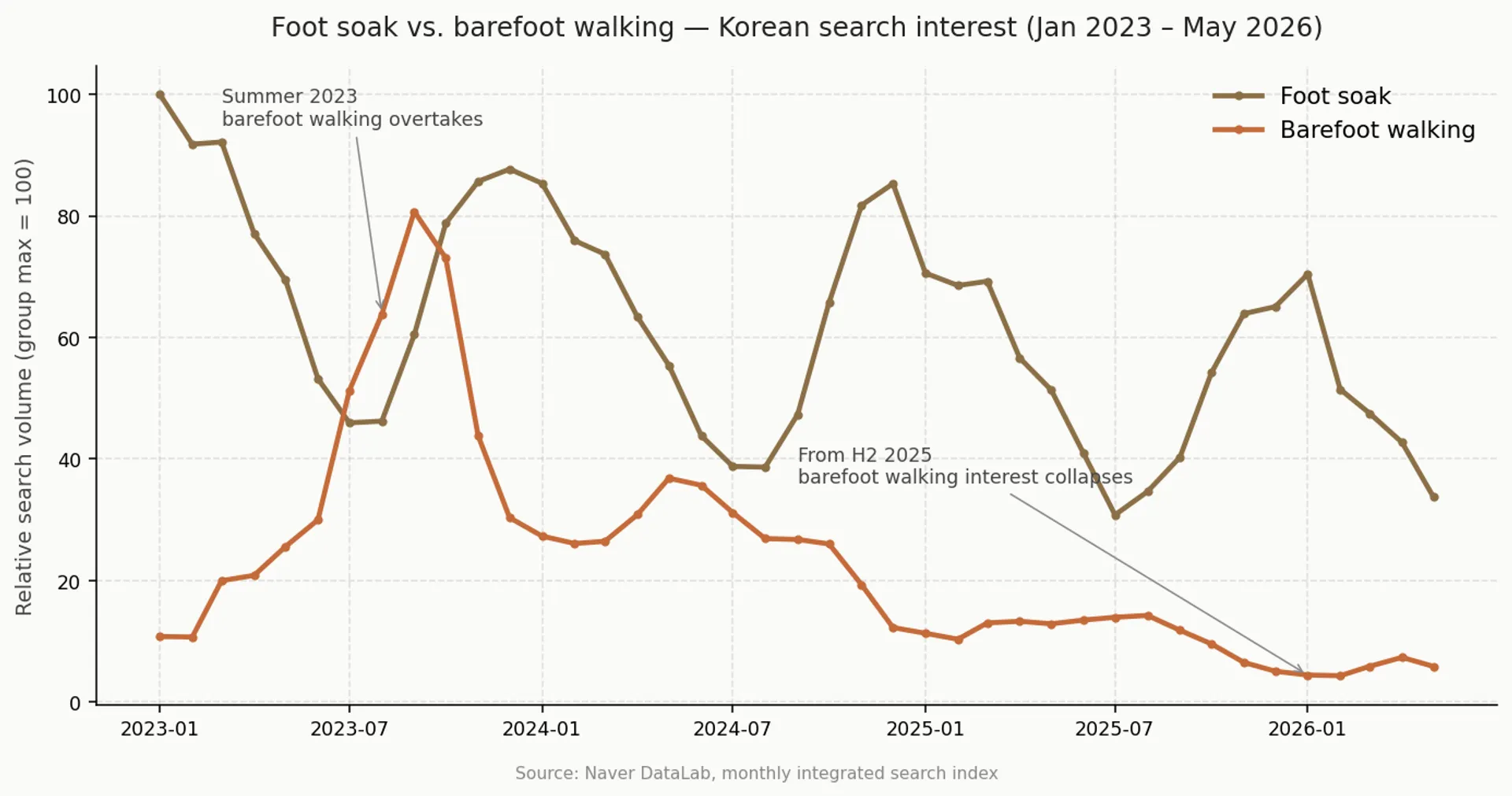
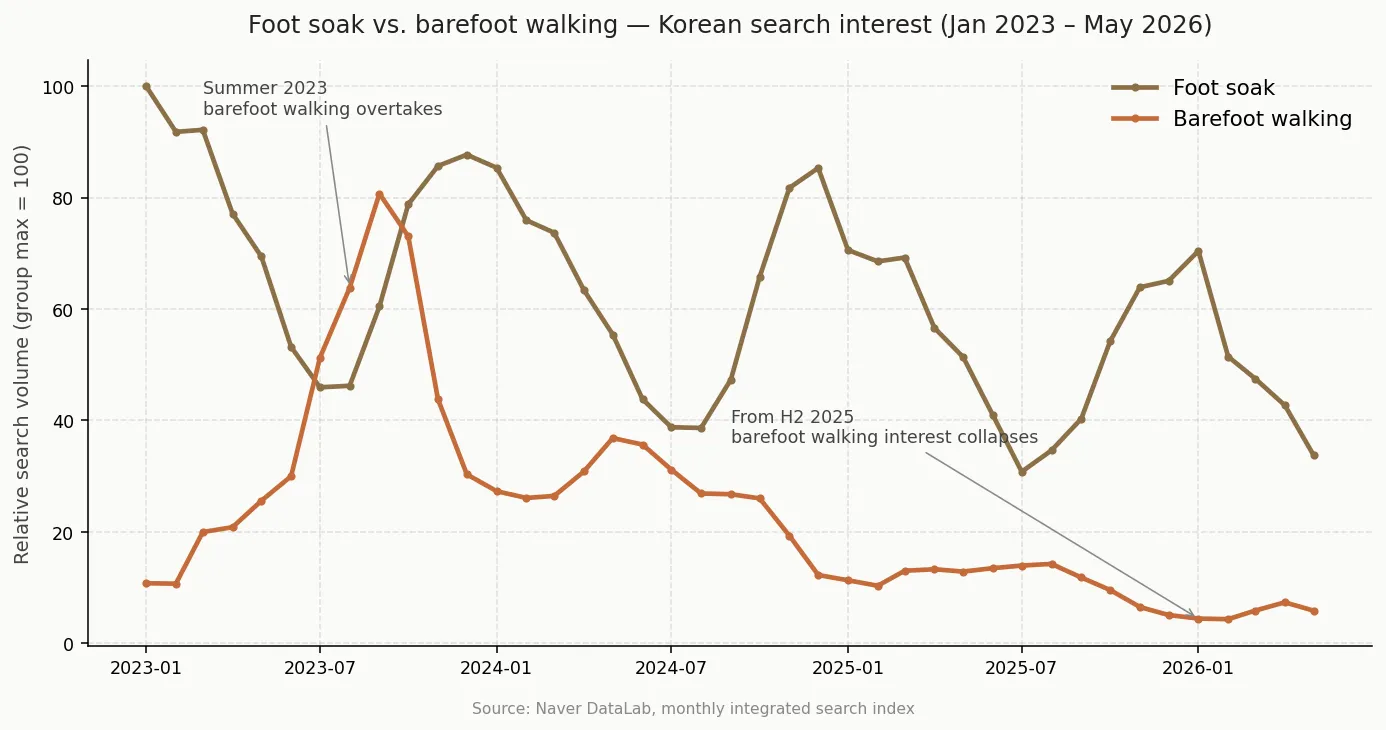
Naver, the dominant Korean search engine, runs a public trend index called DataLab. Pull “foot soak” (족욕) and “barefoot walking” (맨발걷기) on the same chart for the last three and a half years, and the shape of the Korean wellness market becomes hard to miss.
Two things stand out.
The first is the summer of 2023. Barefoot walking shot past foot soak almost vertically, peaking in September of that year. For a brief window, it looked like the country had found a new default wellness behavior, and a wave of small books, YouTube channels, and city investments followed.
The second is the slope after the second half of 2025. By early 2026, barefoot walking search interest had fallen below 8 on a scale where foot soak still sits at 33 to 70. The graph is not a soft cooling. It is a sharp drop, not a soft cooling.
And foot soak, through all of it, barely moved.
What Both Promise
Read enough Korean question-and-answer threads about either practice, and a strange thing happens. The promises start to look the same.
People ask about barefoot walking when they cannot sleep. They ask about foot soak when they cannot sleep. They ask about barefoot walking when their legs feel heavy after a long day. They ask about foot soak when their legs feel heavy after a long day. The categories converge on three quiet things: better sleep, lighter legs, a way to close out an evening.
A licensed Korean medicine doctor answering one of the most-viewed barefoot walking questions on Naver’s Q&A platform explained the mechanism this way: stimulating the soles redistributes pressure away from the head and chest, which is why some sleepers report falling asleep faster. Replace the word “stimulating” with “warming” and the same sentence works for foot soak. The two practices target the same physiological complaint from two completely different angles.
This is what makes the Korean experiment so unusually clean. The same person, with the same problem, choosing between two practices that promise the same outcome. Over four years, in the largest sample any wellness market in Asia can offer.
The search behavior settled.
Why One Holds and One Fades
Look closely at the questions people actually ask about barefoot walking, and the limits show up fast.
One person asked how to walk barefoot in a city without drawing stares. Another stopped doing it in November because their feet got cold and started getting cut on rough paths. A third wanted to know if barefoot shoes counted, because winter made the original practice impossible. A cancer patient asked whether the practice was safe with their condition. Diabetics asked about insomnia.
What you read between the lines is that barefoot walking is a five-month activity. It needs warm weather, daylight hours, dry ground, an accessible park, an absence of glass and metal debris, and a body that is not contraindicated. Korea has hot summers, monsoon rains, mosquito-heavy evenings, and freezing winters. The barefoot walking calendar quietly clips itself down to roughly May through September. The trend chart agrees: every barefoot walking peak falls in late summer, and every winter trough goes deeper than the one before.
Foot soak does not have these constraints. It runs year-round, indoors, in a tub of water you can control. The peak is winter, not summer. December and January searches for foot soak in 2026 were stronger than the same months in 2023. The category has been quietly compounding while the louder trend cycled through its hype curve.
There is also the matter of what each practice can actually deliver. The case for barefoot walking rests heavily on a concept called “earthing,” the idea that electrical contact with the ground regulates inflammation and sleep. The published evidence for this claim is thin and contested, and most of the studies cited by advocates are small, often funded by parties with commercial interest in earthing products. The barefoot walking experience itself, mechanical stimulation of the soles plus time outdoors, is real and probably useful. The earthing layer is mostly marketing.
Foot soak, by contrast, is a thermal intervention with measurable physiology behind it. Warming the feet triggers distal vasodilation, which accelerates the drop in core body temperature that the brain reads as a sleep signal. The 1999 Nature paper “Warm feet promote the rapid onset of sleep” is still cited in chronobiology textbooks today, and the mechanism has held up across follow-up studies including a 2021 paper in the Journal of Clinical Sleep Medicine. Add herbal infusions selected for a specific evening or recovery purpose, and the practice becomes a designed ritual rather than a hopeful one.
The Indoor Ritual Stays
The simplest way to read the chart is not as a contest. Barefoot walking is not failing. The trails are still being built, and a slower, steadier audience will keep walking them. What the chart shows is the difference between a wellness moment and a wellness habit.
A wellness moment has a peak season and a hype cycle. It depends on weather, on infrastructure, on a story that needs to be retold every spring. It rises sharply, sells books, fills parks for two summers, and then fades to a background practice.
A wellness habit fits into a life that runs in all twelve months. It does not require permission from the season. It does not need a city to pave a path. It quietly anchors a day, and the search index reflects this in a pattern that holds across years: winter peak, summer trough, no collapse in between.
This is the structural reason Korean herbal foot soak has remained interesting to the international wellness conversation even as flashier categories have come and gone. It is one of the few wellness practices where the calendar, the physiology, and the cultural ritual are all aligned. The formula, the temperature, and the herbs are all parameters someone can design. The barefoot walking experience, for all its appeal, depends on a park, a season, and a country willing to maintain both.
For a brand thinking about which side of that line to build on, the Korean four-year experiment is about as clear an answer as a market ever offers.
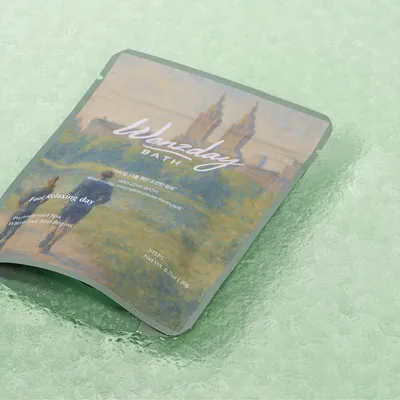
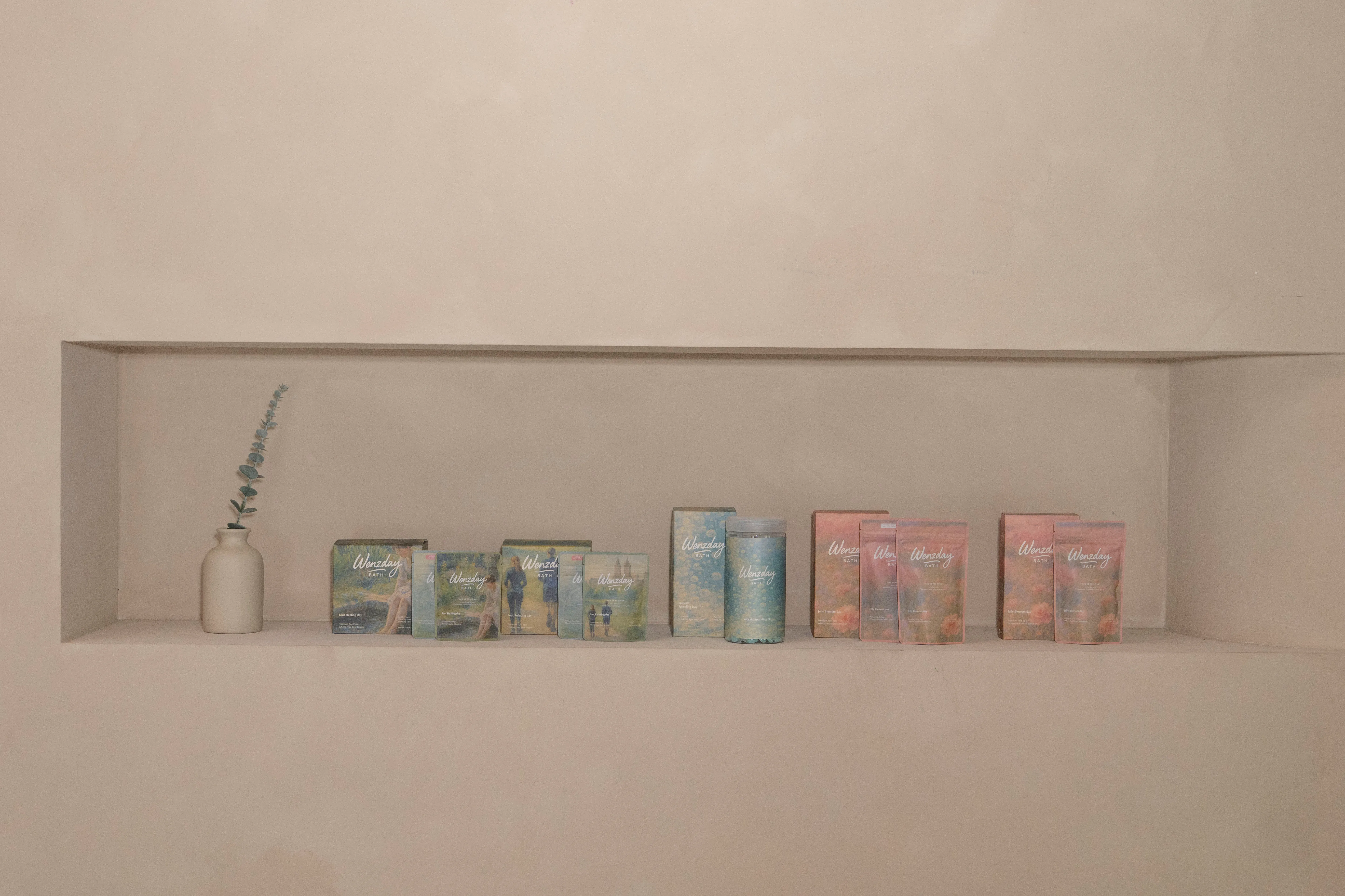
That is the idea behind Foot Healing Day and Foot Relaxing Day. One is built around warmth that holds into the night. The other is built around the lighter finish that suits an active day or a long walk. Both start from the same insight as the chart: the ritual that lasts is the one people can repeat.