Spring Is Supposed to Feel Like Waking Up
The flowers are out. The days are long. And you are exhausted.
Not sick-tired. Not stressed-tired. Not sleep-deprived.
Just a persistent, low-grade heaviness — the kind that makes you want to nap at 2pm and fall asleep on the couch by 9.
You are not imagining it. In a recent study, nearly 47% of respondents said they regularly experience what they call spring fatigue.
Here is the strange part. When researchers actually measured fatigue, sleepiness, and sleep quality across the seasons in the same group of people over a full year, they found no meaningful seasonal increase in spring. The feeling is common enough to have a name. The measurable signal? Harder to pin down.
In other words, people reliably feel it — but physiology does not neatly confirm it.
So what is actually happening?
1 Hour and 48 Minutes
Between March 1st and April 15th in Seoul, the day gets about 1 hour and 48 minutes longer. That is roughly 2.4 minutes of extra daylight every single day.
For your body, that is not a gentle nudge. It is a recalibration signal.
Your circadian rhythm — the internal clock that regulates sleep, hunger, hormones, and body temperature — is anchored to light. Strong light exposure can shift melatonin timing by 1 to 3 hours. As spring light intensifies rapidly, your body clock has to reorient itself.
The recalibration itself is not painful. But it creates a temporary misalignment — and that mismatch is often experienced as fatigue.
The Brain Chemistry Piece
There is a serotonin connection worth understanding.
A study published in JAMA Psychiatry measured serotonin transporter binding in the human brain across all four seasons. In fall and winter, binding levels were 10.6% to 16.1% higher than in spring and summer — and the difference tracked directly with daily sunlight hours. Less sunlight meant higher transporter activity, which means the brain was pulling serotonin out of the synapse faster. A kind of seasonal low-serotonin state.
As spring arrives and light increases rapidly, this system starts shifting. But it does not happen all at once. The “coming out of winter” transition is its own physiological demand — your serotonin system is adjusting while your body clock is also adjusting, at the same time, against a backdrop of temperatures that swing 10 degrees between morning and afternoon.
That combination offers a plausible explanation for what you feel.
What Korean Medicine Calls It
Korean medicine does not have a clinical diagnosis for spring fatigue. But it has something arguably more useful: a framework for why the spring transition is physiologically demanding.
In the five-element system underlying Korean and Chinese medicine, spring belongs to the Wood element. In the body, Wood corresponds to the Liver system (gan, 肝). Spring is described as the season of 발진 (發陳) — literally, bringing forth what was stored. The energy that accumulated through winter starts moving outward and upward.
If your body came through winter in good shape, this feels like vitality. If winter depleted you, the spring surge arrives and you simply cannot keep up.
The Donguibogam, the foundational 17th-century Korean medical text, does not name “춘곤증” as a formal condition. But it clearly treats spring as a physiologically distinct season belonging to the Liver — the system responsible for the smooth flow of qi and blood through the body. In this framework, fatigue in spring is often interpreted as a mismatch between the body’s internal state and the season’s upward, outward movement.
While the language is different, both perspectives arrive at a parallel conclusion: the body is adapting to rapid seasonal change.
What the Donguibogam Actually Recommends
The spring principles in the Donguibogam read less like a prescription than a rhythm adjustment:
- Sleep a little later than in winter; wake early
- Move the body freely — do not stay still
- Spend time in sunlight; protect against wind and sudden cold
The underlying logic is circulation. Spring is a season of movement. A body that stays sedentary, that does not absorb the new season’s light, that stays contracted the way it did in winter — that body struggles to transition.
This is where warming practices in spring begin to make sense. Not aggressive stimulation. Gentle, sustained circulation.
Where Foot Soaks Come In
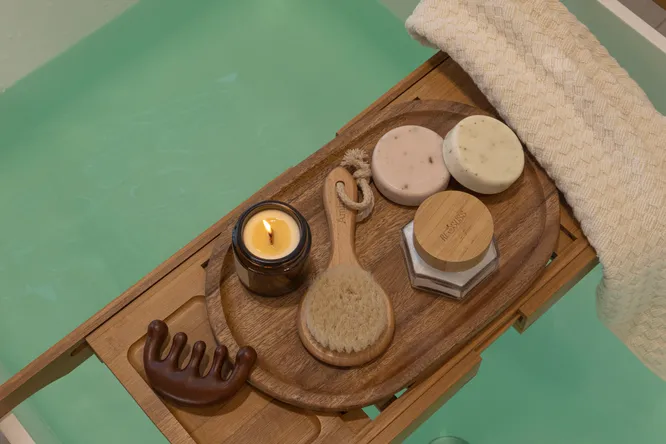
A foot soak sounds simple — but the mechanism is surprisingly precise.
Warm water raises the temperature of the skin on your feet and lower legs, triggering distal vasodilation — expansion of blood vessels at the body’s periphery. This releases heat from the core, which is exactly what the body needs to ease into sleep.
Sleep physiology research has consistently shown that distal vasodilation is one of the key mechanisms behind sleep onset. When peripheral skin temperature rises, core body temperature drops slightly — and that drop is a signal to the nervous system that it is time to rest.
A 2021 study with 20 healthy women found that a short foot soak at 40°C significantly reduced self-reported fatigue, tension-anxiety, depression, and confusion scores — even without aromatherapy or essential oils. The foot soak itself was the active element.
Translated into the Korean medicine framework: warming the feet gently stimulates circulation at the body’s extremities, supports the smooth Liver-system flow that spring demands, and gives the body’s recalibration a repeatable, physical anchor.
It does not fix the circadian shift. It supports the body while the shift happens.
Not a Cure. A Practice.
Spring fatigue is probably not one thing. It is what happens when your body clock is resetting, your serotonin system is adjusting, morning and afternoon temperatures are 10 degrees apart, and you are expected to function normally through all of it.
No supplement resolves that. No single ingredient skips the adaptation.
What traditional Korean medicine understood — and what thermal therapy research supports — is that the body responds well to consistent, low-intensity support during transitions. Warmth. Movement. Sleep rhythm. Light.
A foot soak before bed is not a medical intervention. It is a practice that gives the body a specific, repeatable signal: slow down, circulate, recover.
In a season where everything is trying to wake up at once, your body does not need more stimulation.
It needs a way to keep up.
Want to understand the sleep mechanism in more detail? We explored it in The Science Behind Foot Soaks and Sleep. For the traditional Korean practice this connects to, What Is Jogyok? is a good starting point.