An exercise taught to people who can’t exercise
After surgery, or with a leg in a cast, or on prolonged bed rest, patients are shown one of the simplest exercises in medicine: pull your toes up toward your shin, then point them away, and repeat. Nurses teach it because patients who can’t walk are at real risk of a blood clot forming in the deep veins of the leg, and this small movement is a documented part of preventing that.
It works because it copies something walking normally does on its own. Most people never think about the exercise at all, because they never stop moving long enough to need it.
A desk job stops you for eight hours a day. So does a shift spent standing at a register, or a day teaching a class on your feet. Different situation, same stalled pump, just slower and less dramatic than a hospital bed.
The pump that’s supposed to be running
Blood that reaches your feet has to travel back up to your heart against gravity, and the calf muscle is what makes that trip possible. Every step contracts and releases the calf, squeezing the veins running through it and pushing blood upward one small pulse at a time. One-way valves inside those veins keep the blood from sliding back down between pushes. It’s often called the body’s second heart for exactly this reason, and we’ve written before about what happens when heat makes the underlying plumbing work harder.
Stop walking for long enough and the pump stops with it. Blood lingers lower in the leg, and by evening that shows up as heaviness, tightness, or visible swelling. None of this requires anything to be wrong with you. It’s what unused muscle does.
What the research says about moving it on purpose
A 2026 systematic review pooled eight studies and 546 people to see whether deliberately pumping the ankle actually changes blood flow, not just how the leg feels. It found that flow velocity in the leg’s deep vein rose with the exercise, and cycles of roughly ten per minute showed a clearer increase than slower ones.
The honest caveats matter here. The people studied were a mix of healthy volunteers and patients recovering from surgery, dealing with paralysis, or otherwise immobile, and none of them were tested after an ordinary day at a desk. Only one of the eight studies was a randomized trial, and the comparison between speeds was made across different studies rather than testing the same people at multiple speeds directly, which the review’s own authors flag as a reason to read the frequency finding cautiously. It would overstate things to claim this proves exactly how much a healthy person gains from doing it at a desk. What it does support is the basic direction: move the muscle, and the blood moves better.
Doing it in the water
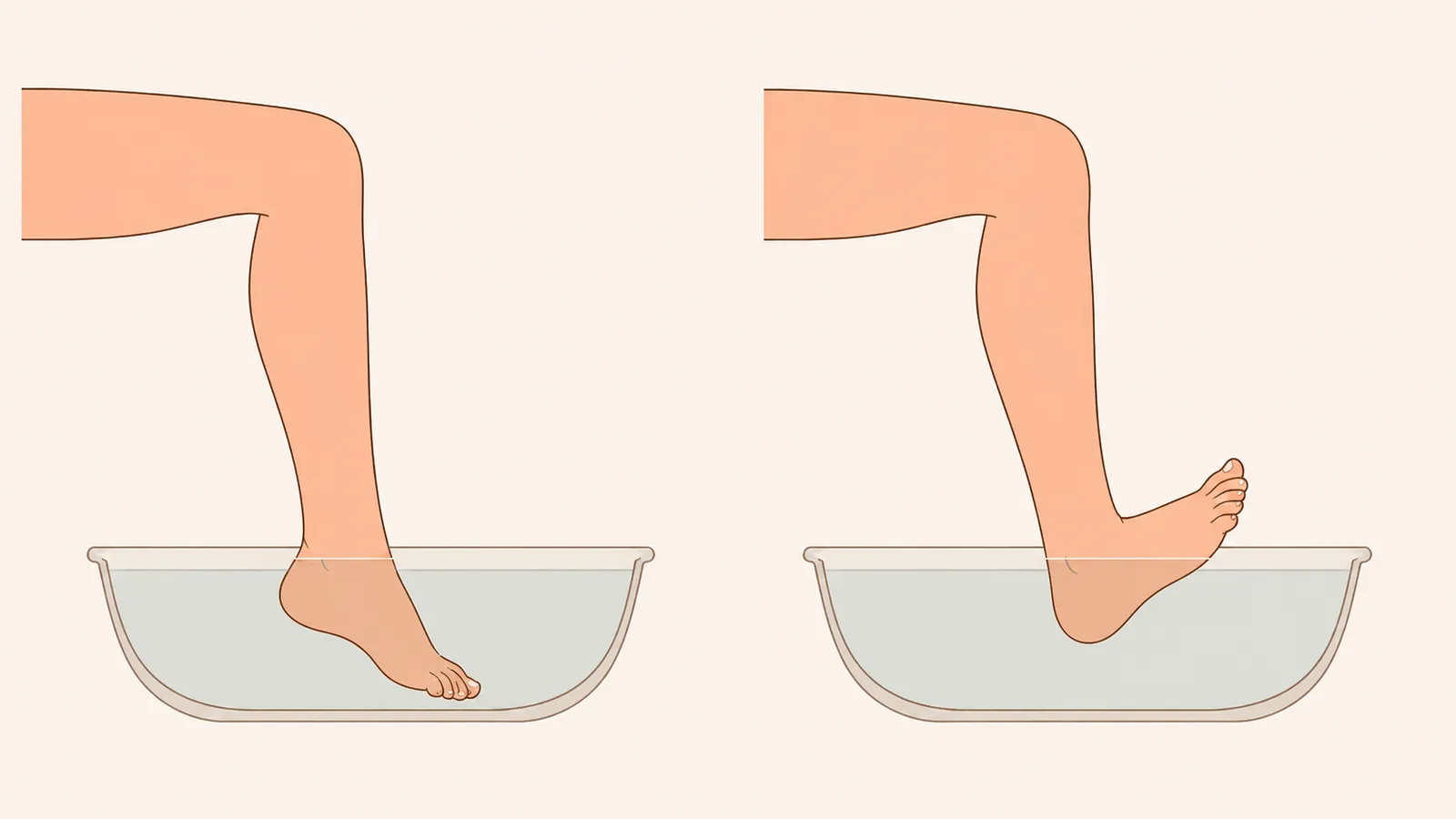
Point the toes away (left), then lift them back toward your shin (right). Alternate slowly between the two positions.
The movement itself doesn’t need special equipment, a chair, or even shoes off. Pull your toes up toward your shin, then point them away, and repeat. Matching the pace used in the research works out to about ten reps a minute, roughly one every six seconds. Slow ankle circles work as a variation.
Doing it with your feet already in warm water isn’t required, but it fits naturally into that time rather than asking for a separate one. The warmth has already eased the muscle before you start moving it, which makes the motion easier, and soaking is a natural pause in the day where you’re sitting still anyway, hands free.
This isn’t a fix that works in one sitting. It’s closer to lending the pump a hand for the minutes you’re paying attention to it, on a leg that’s been stalled for hours.
When to see a doctor instead
Most evening heaviness from a day of sitting or standing eases with a bit of movement and elevation. Some doesn’t, and a few signs mean the next step is a doctor’s office rather than a basin of water: swelling that’s worse in one leg than the other, swelling that hasn’t gone down by morning, or sudden pain with warmth and redness in the calf, which can signal a blood clot and needs prompt attention. If you already have varicose veins, keep the water mildly warm rather than hot and ask a clinician what’s appropriate for you.
Tonight, while you’re already sitting still
If today kept you on your feet or at a desk without much walking in between, this is a good evening to notice. Wash your feet, soak them in warm water, and spend a minute or two pumping your ankles the way a hospital would teach you to, whether or not you ever set foot in one.
Over the Wenzday’s Foot Relaxing Day and Foot Healing Day are made to hold that warmth longer during the time you’re already sitting there. The warmth loosens the muscle. The movement is what actually does the work.
More on foot and leg circulation: Why Your Feet Swell in Summer Heat and The 20 Minutes Your Feet Need After a Long-Haul Flight.