Look at the shoe before the foot
Your feet are what ache at the end of a day in sandals. The problem may be the shoe.
Take a step in a sandal and your heel comes up first. The shoe does not follow. It stays flat on the ground, a wedge of air opens up under your heel, and at that moment the only place shoe and foot still meet is the front of the foot.
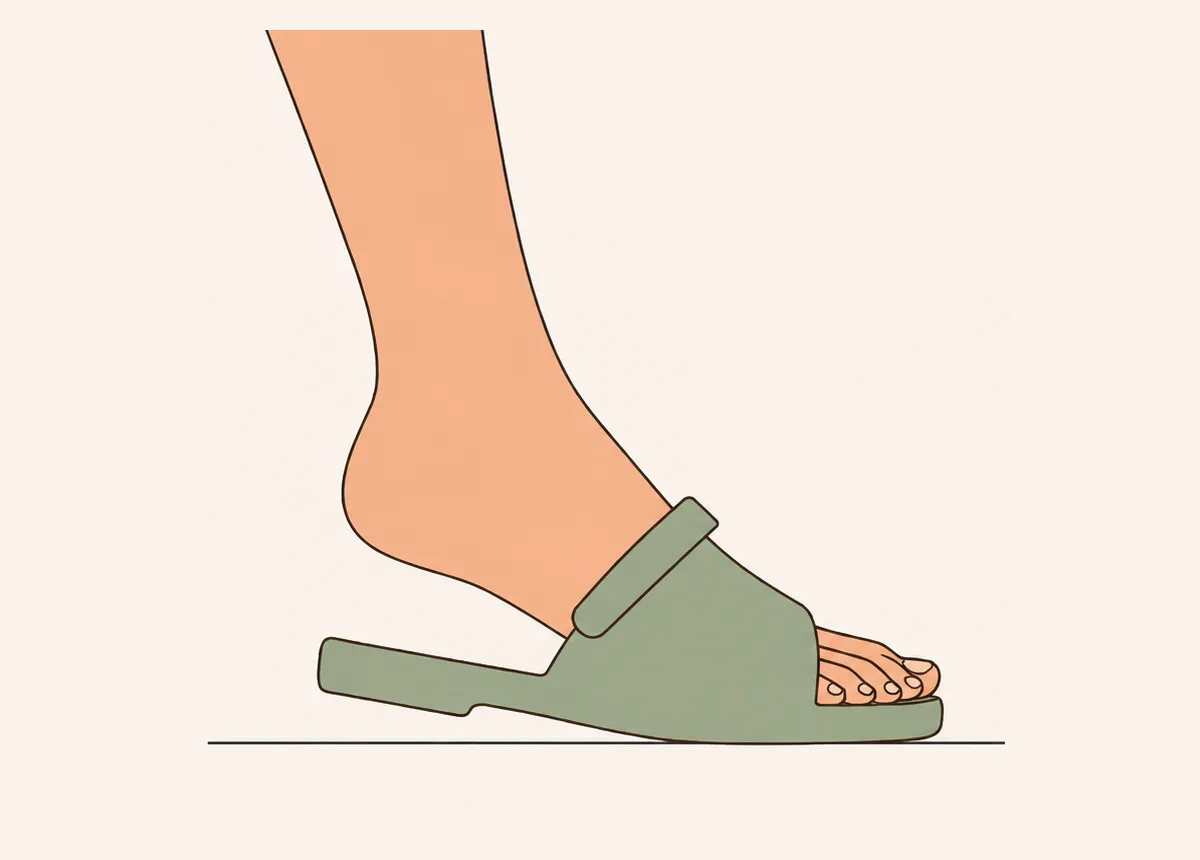
A wedge opens between the heel and the sole. The only remaining contact is the band across the front of the foot.
So the work of keeping the shoe on falls there too. In one study, researchers put thong-style flip-flops on thirteen children, filmed them with a fourteen-camera system, and compared that footage with their own barefoot walking. While walking, the angle the ankle bent upward during ground contact increased by 10.9 degrees, and the big toe bent back less rather than more. The middle of the foot bent further downward. The researchers read this as the foot working to keep the shoe on, and applied the phrase gripping action to the midfoot movement.
Which leaves two things to adjust. What happens at the back of the shoe, and whether it fits.
First, put the heel strap down
Wearing Crocs with the strap flipped forward is a common enough sight. In a study published this year, thirty-one participants walked under three conditions: in socks, in Crocs with the heel strap behind the heel, and in Crocs with the strap flipped forward.
Walking speed and stride length were significantly greater in the strap-down condition than in the other two. Hip and knee angles differed only between walking in Crocs and walking in socks, not between the two strap positions. The ankle measurements, the authors write, suggest that Crocs worn with the strap off the heel are not good for how the ankle moves.
Where that one strap sits is the whole difference.
Second, check the size
A review that gathered eighteen studies on footwear fit found that between 63% and 72% of participants were wearing shoes that did not match the width or length of their feet, and that poor fit was associated with foot pain, deformity of the smaller toes, corns, and calluses.
Which way the mismatch runs depends on the group. Among children with Down syndrome, older people, and people with diabetes, between 46% and 81% were in shoes too narrow for their feet. Among older people the review also records shoes that matched the width but ran long. The 63% to 72% figure pools children, adults, older people, people with diabetes, and specific occupational groups, so read it for scale rather than as a rate.
Do you need different shoes?
Summer sandals have a reputation for being bad for your feet. But the flip-flop study measured neither pain nor disease. It recorded joint angles in thirteen children and never asked anyone where it hurt.
The researchers made a related point in their opening paragraph. Health professionals connect this footwear to foot problems and deformity, they wrote, despite a lack of quantitative evidence to support or refute the link.
There is no reason to throw your sandals out. The strap and the size are what to adjust.
In the evening
Both of those are adjustments to the shoe, so they take effect the next time you put the sandals on. Neither does anything for feet that already hurt.
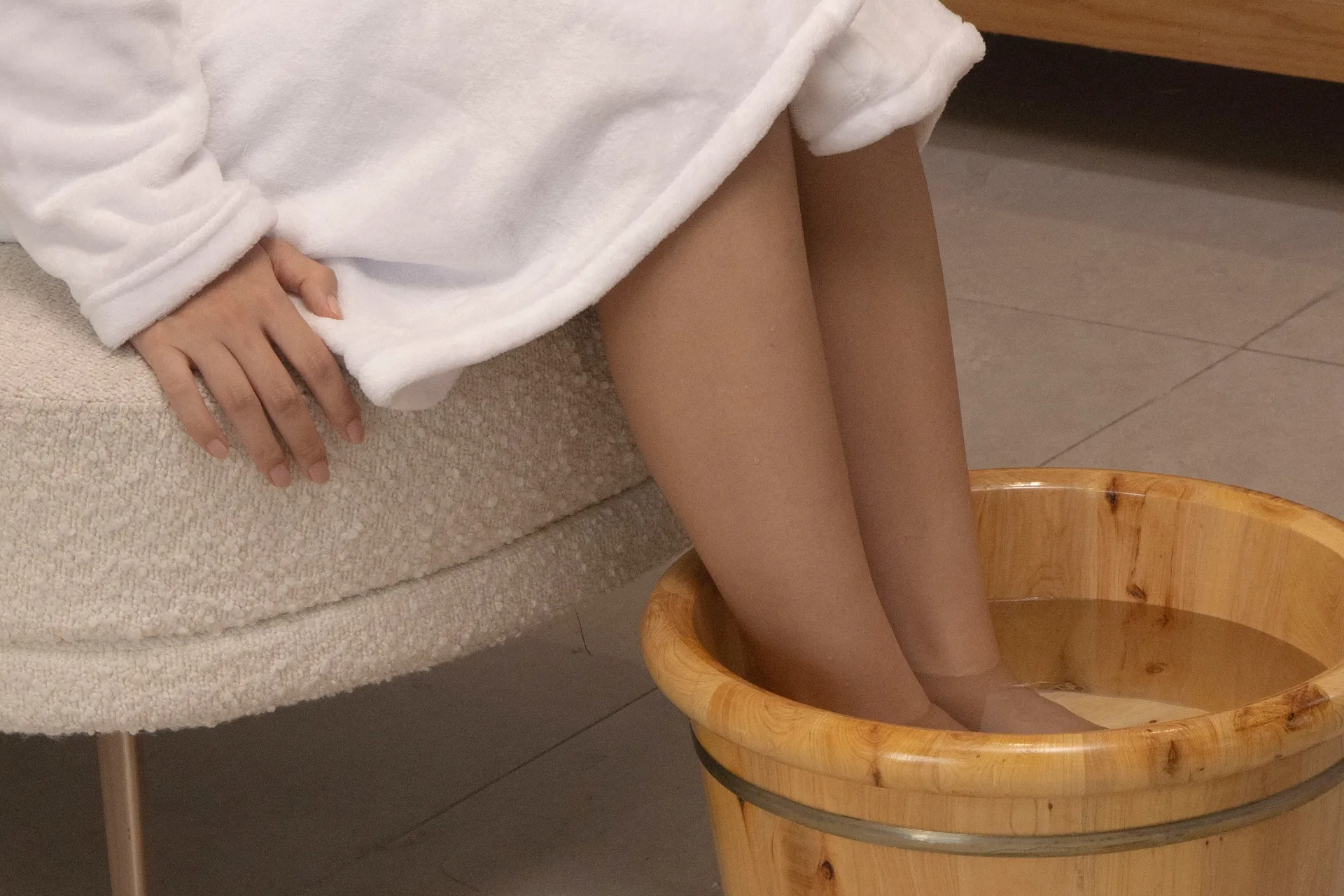
What is left for the evening is simple. Wash your feet, soak them in warm water for 15 to 20 minutes, then dry them, including between the toes.
If you put cream on afterwards, there is one place to leave alone. The international foot care guidelines for people with diabetes say to use moisturizer on dry skin but not between the toes. The toes press against each other and almost no air moves between them. That is why you dry there after washing. Cream puts the damp straight back.
A soak does not undo what the foot did all day. If a sore toe is unchanged after several days, if your heel hurts most on the first step in the morning, if a swollen area feels hot, or if anything goes numb, a clinician comes first. There is a separate piece on why that first step is the worst one.
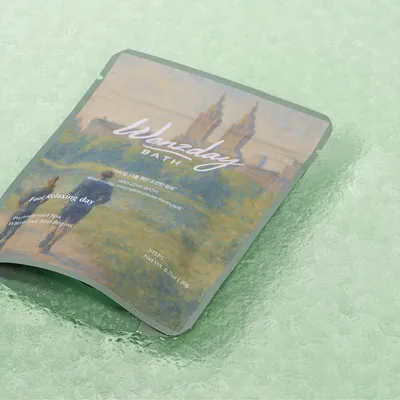
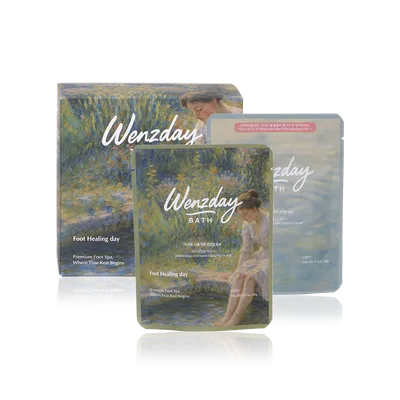
Foot Relaxing Day and Foot Healing Day from OVER THE WENZDAY are foot soaks made for that stretch of the evening. Each comes as two powder sachets. Step 1 turns the water into a gel around your feet, and after 15 to 20 minutes Step 2 turns it back into water while smoothing rough skin and adding hyaluronic acid.
What to check tonight
So there are two things to check. Whether the heel strap is down, if there is one. Whether the shoe matches the length and width of your foot.
The front of the foot spent the day with a shoe hanging off it. It rests in the evening.
For more on summer foot care, read Athlete’s Foot Does Not Always Itch, Why Your Feet Swell in Summer Heat, and Plantar Fasciitis: Ice or Heat?.