The stereotype gets in the way
Ask most people what athlete’s foot looks like and you get one picture. The skin between the toes goes soft and white, splits, stings, and above all itches. That picture is accurate for one common form of it. It is also the reason another form gets mistaken for plain dry skin.
There is a version that spreads across the sole and up the sides of the foot, in a pattern dermatologists call the moccasin type after the shoe it resembles. It leaves fine, powdery scale rather than raw, wet skin. Clinical references describe it in flat terms: it looks like dry skin, and it often does not bother the patient at all. One description notes that the sole takes on a powdery dry look with a fine scale that appears to accentuate the lines of the skin.
So an absence of itching rules out less than people assume. If your soles have been flaking white all summer and you settled the question early because nothing itches, that reasoning is thinner than it feels.
None of which means every flaking sole is fungal. Skin that is simply dry does exactly this, and feet are unusually prone to it for reasons of construction.
Feet are built without the oil
The sole, along with the palm, carries the thickest layer of dead surface cells anywhere on the body. That layer is armour. It is what lets you put your full weight on a floor all day.
What the sole does not have is the film of oil that keeps that armour supple. Sebaceous glands mostly sit alongside hair follicles, and the sole has neither. Research on plantar skin describes it as lacking hair and sebaceous glands almost entirely while carrying a great many sweat glands, with a greatly thickened outer layer.
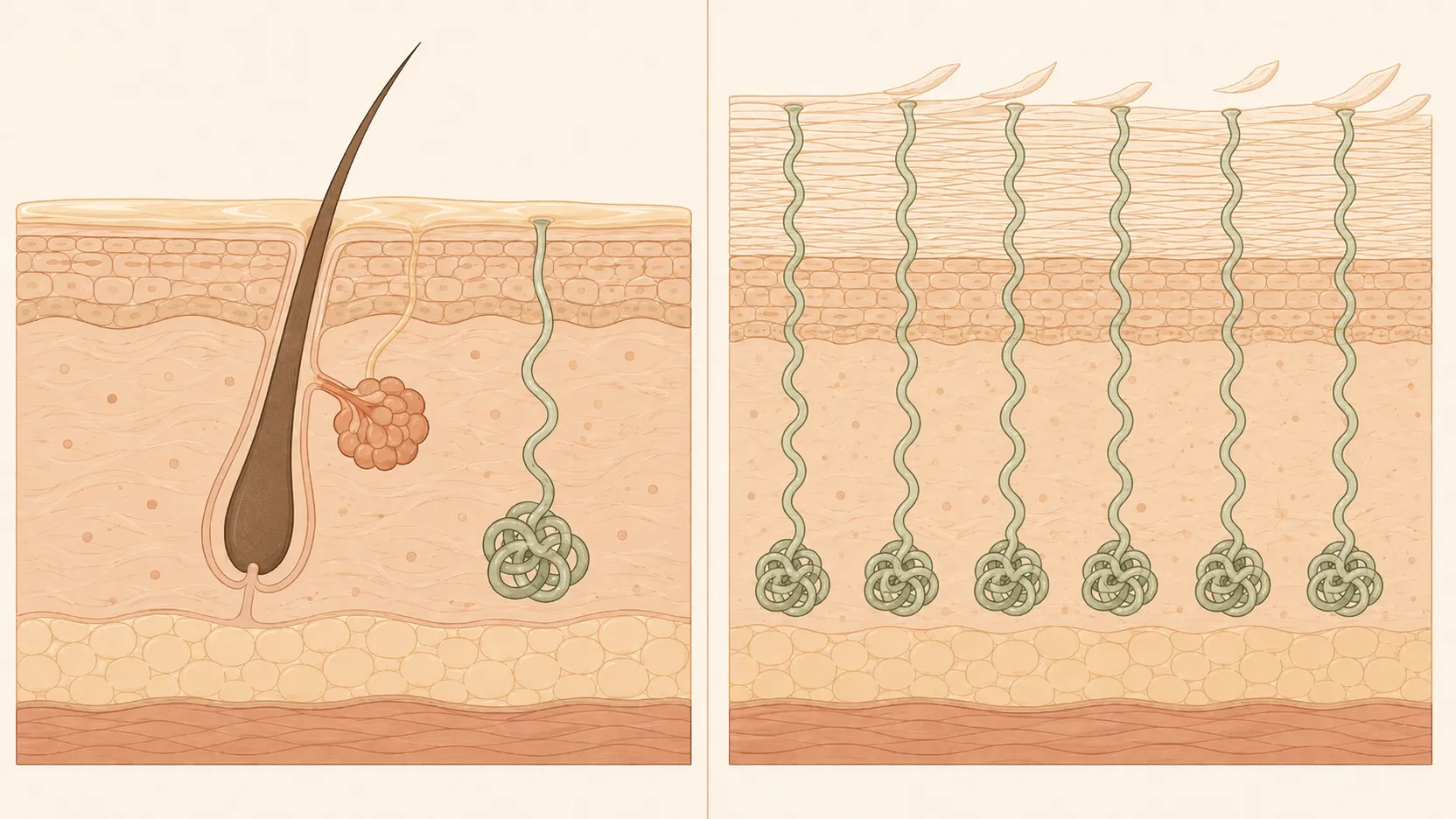
Left: skin elsewhere on the body, where an oil gland sits beside each hair follicle and its output covers the surface as a film. Right: the sole, with no hair and no oil gland to supply that film, a much thicker outer layer, and sweat glands packed far more densely.
Put those together and you get a thick surface layer with no oil film over it, on skin that sweats heavily. Add a day of pressure and friction inside a shoe, then a cycle of washing and drying every evening, and the thick surface layer dries from the top down and lifts away in pale flakes. Your face has oil and rarely does this in the same way. Your feet have none and do it constantly.
Seen that way, flaking soles are less an event than a property of the skin itself. Which is also why the first move is not diagnosis.
Start with moisturizer, and read the result carefully
The usual first step is unglamorous. Wash your feet at night, dry them properly, apply a cream, and keep it up for several days.
Skin that is dry and nothing more tends to answer quickly. The pale, lifting patches settle and the surface stops shedding. If several days of consistent moisturizing changes nothing, standard guidance is to start considering other causes.
Note carefully what that is and is not. It is a direction, not a test. Improvement with moisturizer does not rule out anything, because a fungal infection can sit under skin that is also dry, and dryness responding to cream says nothing about what else is on the foot. The reason this step comes first is that it is harmless, cheap, and often sufficient, not that it settles the question.
When it keeps spreading
The situation worth paying attention to is flaking that holds steady through consistent moisturizing, or widens. Three things are worth knowing about here.
The first is the athlete’s foot that does not itch, the moccasin pattern described above. It covers the sole and the sides of the foot broadly rather than sitting between the toes, and it leaves a fine dry scale. Because it looks so much like dryness, clinicians look at whether the scaling has a defined edge to it rather than fading evenly into normal skin. Nails often tell on it: thickening or discoloration of the toenails alongside scaling soles is worth mentioning to a doctor.
The second is peeling in small round patches. Skin lifts in thin circular flakes, usually without itch, the exposed skin underneath can feel tender, and it recurs every few weeks. This is keratolysis exfoliativa. It is benign, it is more common in summer, and it is associated with sweaty skin. Two honest caveats: it appears on the palms far more often than the soles, and management is about reducing irritation and moisturizing rather than any cure, since it tends to come back.
The third is scale pitted with tiny craters, as though the surface had been punched with a fine hole punch. That is pitted keratolysis, a shallow bacterial infection of the outer skin layer that favours sweaty feet. Odour commonly comes with it, and it can be pronounced enough to be what sends someone to a clinic.
What follows is not a diagnostic key. It is a set of observations that might help you decide whether a clinic visit is worth booking. The same cause can look different on different feet, and more than one thing can be present at once.
| How the flaking looks | Itch | After several days of moisturizer | Other signs | |
|---|---|---|---|---|
| Simple dryness | Surface lifts broadly, sheds like fine powder | Usually none | Tends to settle | Rises and falls with season and environment |
| Moccasin-type athlete’s foot | Covers sole and sides, fine scale, skin lines look accentuated | None or mild | Unchanged, sometimes wider | Toenails thickening or discoloured |
| Keratolysis exfoliativa | Thin round patches lifting at the edges | Usually none | Settles, returns in a few weeks | More common in summer and on sweaty skin, and far more common on palms |
| Pitted keratolysis | Surface pitted with small craters | Usually none, sometimes sore to walk on | Little change | Heavy sweating and noticeable odour |
To say it once more: this is not a diagnosis. Appearance alone often cannot separate these, and conditions with nothing to do with any of them, eczema and psoriasis among them, can present on the sole as well. You may read that fungal infection tends to be asymmetrical while eczema and psoriasis lean symmetrical. That is a tendency rather than a rule, and the moccasin pattern in particular often turns up on both soles at once.
Checking is a scrape and a microscope
The check itself is quick. A clinician scrapes a little of the loose scale, treats it with potassium hydroxide, and looks for fungal filaments under a microscope. It is not a lengthy procedure. A negative result does not always close the question, so a culture is sometimes sent afterwards.
Worth having someone look if any of these apply.
- Consistent moisturizing has changed nothing, or the area is spreading
- Toenails are thickening, crumbling, or turning yellow
- The skin has cracked deeply enough to hurt or bleed
- There is redness, warmth, swelling, or weeping
- The odour has become pronounced
One caution about the shelf at the pharmacy. The over-the-counter corn and callus removers that contain salicylic acid are not for indefinite use on your own initiative, since they can damage the healthy skin around whatever you are treating. Guidance is to avoid them rather than reach for them by default, and it is emphatic about two groups in particular: people with reduced sensation in the feet, and people who are immunocompromised.
If you have diabetes, the rule is firmer. Do not pare hard skin or calluses yourself, and have your feet managed by a clinician instead, because a foot with dulled sensation gives you no reliable feedback about how deep you have gone. For the same reason, check before making long foot soaks a habit. Skin that cannot feel heat accurately is skin that can be scalded by water that seemed fine, and a long soak dries the surface out rather than conditioning it.
Where an evening soak fits
If dryness turns out to be the answer, the evening version of this is short. Wash, warm, dry, moisturize.
Do not skip the drying. Warm, humid weather works on damp skin between the toes, which is why nearly every piece of foot advice for the season converges on the same dull instruction. There is one stretch of the Korean year when that gets genuinely difficult, and we wrote about it during the monsoon.
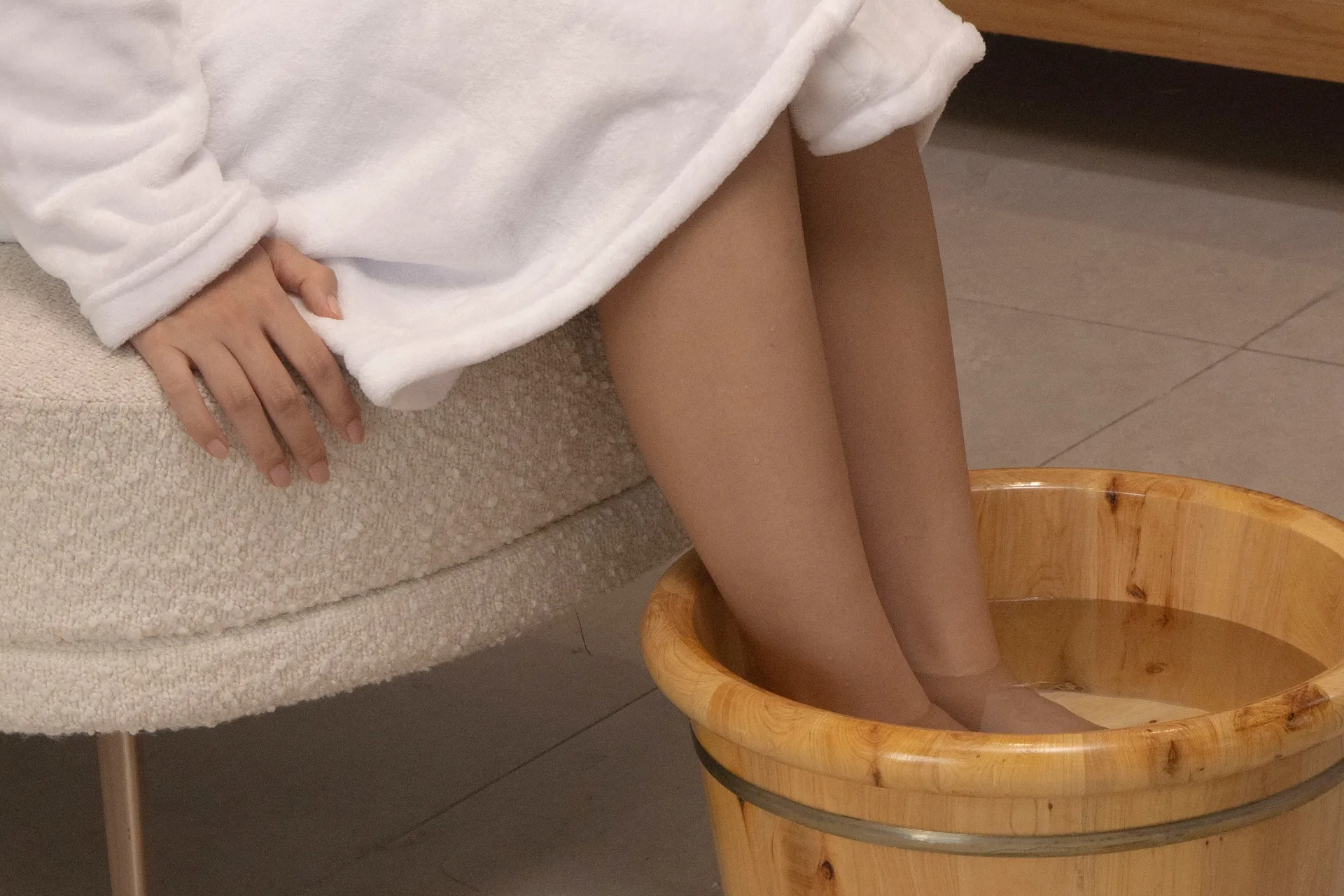
Warm water belongs between washing and drying, and it is worth being precise about what it does. In clinical procedure for thickened, hardened skin, soaking is not the treatment. It is the step immediately before careful paring, roughly twenty minutes in warm water so the hardened layer softens first. The point is that softened skin does not have to be forced. Nothing about that requires scrubbing.
Foot Relaxing Day and Foot Healing Day from OVER THE WENZDAY are made as a slush gel rather than plain water in order to protect that stretch of time. A basin of water sits exposed to the air and, depending on the room, can go lukewarm within about five minutes, well before your feet have had a chance to settle. The gel holds its warmth longer. The final step is a powder that smooths the surface gently and adds hyaluronic acid to hold water in, working by softening and settling rather than by abrasion. Skip it on skin that is cracked or broken.
One thing needs saying without hedging. A foot soak is not a treatment. If a fungal or bacterial infection is what is on your foot, warm water will not resolve it, and the itchy between-the-toes form that most people picture has its own story. Care comes first from a clinician. The evening ritual sits on top of that, not in place of it.
The end of the day, and the feet you walk on
Flaking soles are, in many cases, undramatic. Skin with no oil supply dries out and sheds, and when that is all it is, cream handles it.
The line worth remembering is a single one. If it keeps spreading despite the cream, it is no longer a question moisturizer can answer. Knowing where that line falls is what keeps you from worrying about nothing, and equally from ignoring something for a season.
Take the sandals off, wash, soak briefly in warm water, dry, and put cream on. For most summer evenings that really is the whole of it.
For more on summer foot care, read In Korea, “Athlete’s Foot” Peaks in the Search Bar Every June, Jangma: When Korea’s Long Rain Begins, Feet Notice First, and Baking Soda Foot Soak: What It Actually Does (And Where It Falls Short).